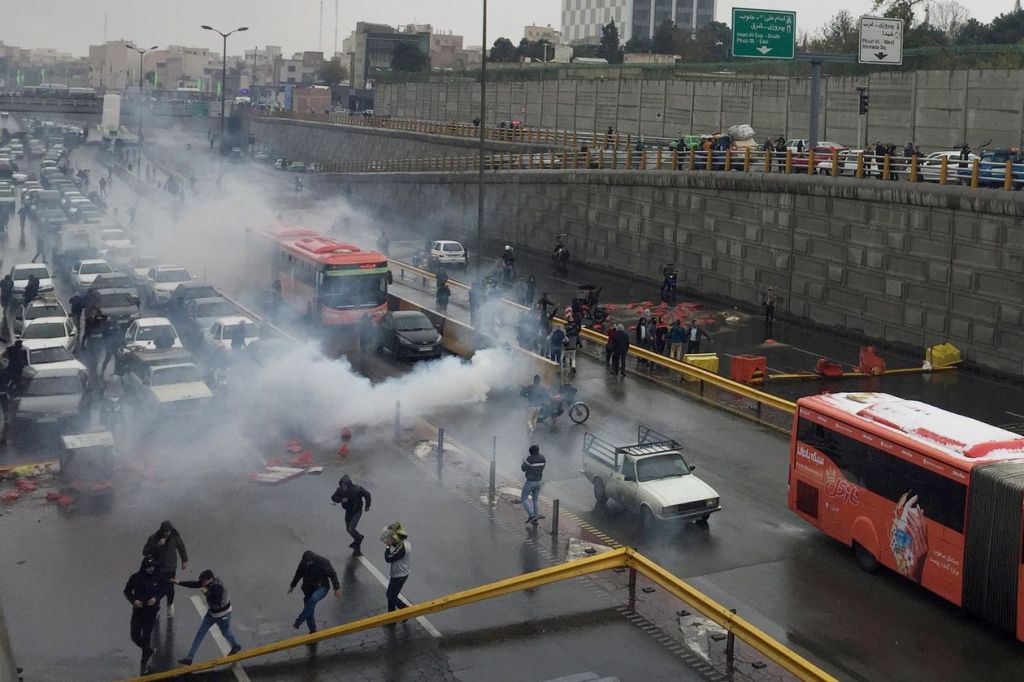
Demonstrations of Iranian protests over the recent rise in fuel prices threatened the security of Tehran this past Monday as the Islamic Revolutionary Guard struggled to maintain the public unrest. Widespread unemployment and the collapse of the Iranian rial forced many to the streets through opposition to the national government.
Since the United States removed itself from the Iranian Nuclear Deal in 2015, the imposed tariffs, recently strengthened August, have been the most effective move in combating this authoritarian state. Without access to global markets, and specifically that of the Iranian oil industry, the country has slowly collapsed upon itself. The recent protests should be viewed as a foreshadow for the beginning to the inevitable: a loss of control to the public and the threat of action in numbers.
When a United States drone was shot down over the Persian Gulf from Iranian missiles this past June, many Americans saw an unexpected side of their president. Though the Trump administration toyed with the idea of a retaliatory strike, the drone was unmanned and ultimately prompted an immediate cyberattack on Iranian military servers and the following tariffs just two months later.
Cyber attacks, drone strikes and military invasions all posses the unfortunate quality for the aggressor of uniting its opponent populous in defence. However, strategic economic sanctions cripple the country from the inside out and force individuals to blame their personal struggles on their own governing body. As President Hassan Rouhani prepares for his upcoming February parliamentary election, he truly now feels the full weight of being closed off to the surrounding world.
To look at this instance of western intervention on a larger timeline, this interference with Iran stands as an example of how the United States has learned from its history of combating authoritarian regimes.
In 1947 American diplomat in Moskow George F. Kennan wrote an article titled The Sources of Soviet Conduct under the pseudonym X which would develop the backbone to the United States cold war foreign policy. Outlining that a key essential to communism as its necessity to expand to nearby nations, Kennan suggested that the United States take a containment approach to the Soviet Union — limiting influence to the world as effectively as possible without ever taking direct action.
Though already constructed with the purpose of closing itself to the outside world, the Soviet Union, with scarce resources and consistent pressure from Western democracy, eventually collapsed. Compared with extensive developments in nuclear technology deterrents, consistent and controlled containment of this authoritarian regime ultimately became the most lethal tool for the United States in the Cold War.
Iran and the Soviet Union are not similar states. One was an unprecedented experiment of communism following the political uncertainty in post WW2 Eastern Europe and the other is a government plagued by religious extremism with a 10th of the world’s oil reserves. The August tariffs on Iran are a solution in combating an authoritarian regime through moving them into a position similar to one of our historical rivals.
Within the upcoming months we’ll see Iran struggle to find the time to attack Saudi oil reserves and fund their Houthi friends as they place their focus on the threat of their own people. Welcome to economic containment Iran, because when the streets of Tehran start to feel the cold only associated with the Russian tundra, you’ll be wishing we sent a missile in place of our tariffs.
 Seven Star Commentary